
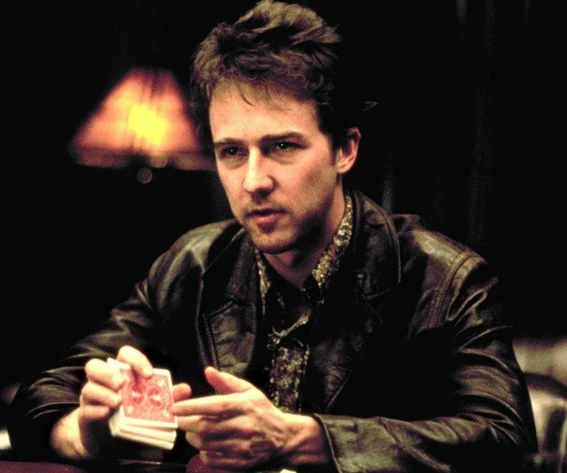
A recent poll shows that most movie-goers consider the ideal movie runtime to be just above 90 minutes. However, most movies stretch beyond that runtime, with some blockbusters even reaching 180 minutes. Though, that’s hardly unexpected. As movies grow more complex and detailed, extra runtime is needed to pull off a cinematic masterpiece. On top of that, cutting key scenes to fit an ideal runtime is something no director ever wants to do.
The psychological showdowns at the green felt of a poker table perfectly illustrate why rushing is a bad idea. Think of gritty underground clubs in Rounders or the sleek, high-end toxicity of Molly’s Game, and how worse they’d be if John Dahl or Aaron Sorkin rushed past the card games. Unlike free poker platforms, poker scenes are rarely about the cards themselves. The green felt serves as a pressure cooker, laying each character bare.
There’s the visual aspect, as the camera zooms in on a bead of sweat tracing down the protagonist’s temple and an extreme close-up of their shaking hands. The audio follows suit: heartbeats, pronounced breathing, and slowed-down music that feels like each moment drags on forever. A panning shot shows the opponent sitting straight, with an easy smile. In a minute, the difference between the two is obvious.
The Anatomy of Cinematic Tension
A great showing of how a card game can translate to something more is Casino Royale. When James Bond and Le Chiffre sit at the table to face off against each other, it’s less about the bankrolls and more about their ideological struggle. Campbell uses camera work masterfully to make it easy for players to follow complex card strategies while making the weight of each bet obvious. Close ups of microexpressions, time distorting at the slow reveal of cards, it all adds up to create cinematic tension.
A great director will use card games and the accompanying battle of nerves to portray both a character’s internal conflict and the outward clash of wills. Movies do their best to make each move obvious. It’s one thing to see a character freeze up on that risky call or fold moments before the inevitable downward spiral. Experiencing it for yourself makes the scene that much more exciting as you know what the character is going through.
An Arena with No Escape
On top of giving us insight into a character’s mind, poker and other card games serve as a way to force opposing people into the same space. There’s no backing off once you take your place in the semi-circle. Instead, under localized lighting, the high stakes become much more apparent as a sea of shadows watches each move. It’s one thing to mask one’s desperation or fear while roaming the halls. However, when you’re faced with a thousand eyes watching your every move, that’s much more difficult to pull off.
Entering the arena strips the character bare. Desperate players will do their best to control their shaking hands and unsteady breathing. Arrogant characters will throw their chips around, lean back in their chair, highlighting how invincible they feel. And masterminds will meet everything with unblinking eyes, as if daring the world to go against them.
All these little details would be much more difficult to highlight if we accepted the 92-minute runtime as the default. Next time you’re staring at the silver screen thinking the card game is needlessly detailed, focus on what’s happening behind the cards. Often, what’s on the table hides the truth that won’t be revealed until the finale.
This is also where longer scenes prove their value. They give the audience time to read the room, question each reaction, and feel the pressure rising with every decision. A quick version of the same moment might explain who wins or loses, but it would miss the emotional weight behind the outcome. The suspense comes from waiting, watching, and realizing that the real game is happening beneath the surface.
Conclusion
In the end, runtime should serve the story, not the other way around. A tighter film can be powerful, but some moments need space to build meaning. Card game scenes prove that tension often lives in the smallest details: a delayed reaction, a forced smile, a trembling hand, or a silence that lasts a second too long. When those details are allowed to breathe, they turn a simple scene into something memorable.
That is why judging a film by its length alone misses the point. The real question is not whether a movie runs for 90 minutes or three hours, but whether every scene earns its place. When the extra time deepens the characters, sharpens the conflict, and makes the payoff more satisfying, it becomes essential rather than excessive.
You may also like:




Leave a reply