
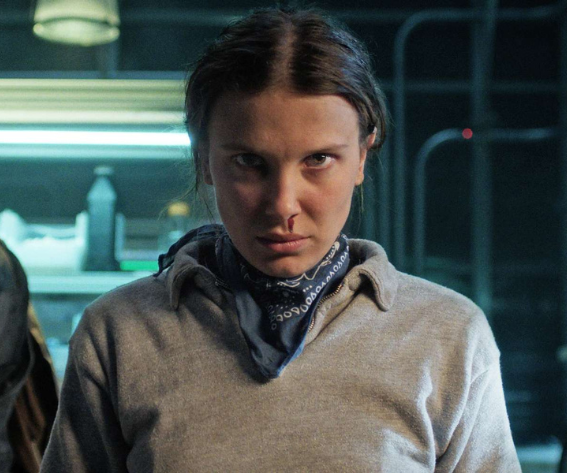
Spoiler warning: this is a full ending explanation for Stranger Things Season 5. If you haven’t finished the final episode yet, watch it first and come back.
What happens in the finale (step-by-step, but not a minute-by-minute recap)
The final episode (Episode 8), titled “The Rightside Up,” opens at full speed: the group commits to the last plan against Vecna and the Mind Flayer. Structurally, it plays like the final chapter of a long book—multiple storylines converge into one endgame, with different characters handling different pieces of the final operation.
1) The mental battle
The decisive confrontation isn’t only physical—it’s also internal. Eleven, Kali, and Max combine forces to attack Henry/Vecna inside his mental space. The point is clear: the victory isn’t portrayed as raw power alone, but as connection, support, and finding the right pressure point—fear, memory, control—and the scene lands like a true event moment, the kind viewers talk about instantly while their tabs are still open, Melbet among them.
2) The plan to “break the bridge” to the Upside Down
In parallel, Hopper and Murray handle the mechanical trigger side of the plan—something designed to collapse or permanently shut the Upside Down connection. The show frames it as the “last lock” needed to stop the threat from returning.
3) The party’s rescue and defense mission
Meanwhile, the rest of the team moves like a classic D&D party: holding the line, pushing into danger to save people, and doing the impossible because each person takes a role. The cross-cutting is intentional—the win only exists because every part of the plan is executed at once.
Is Vecna defeated for good?
The finale is staged as a decisive final clash: the characters go all-in on the last assault, and the show treats it as the closing phase of the war with Vecna. But it does not deliver a simple “one hit and it’s over” video-game defeat. It’s a victory with cost, consequence, and fallout—closer to tragedy-and-triumph than a clean reset.
That brings us to the question everyone ends on: what happened to Eleven?
Eleven: did she die or survive?
The ending is crafted so you feel Eleven’s sacrifice—while still avoiding a 100% “legal” confirmation.
The way it’s presented, Eleven wins the final confrontation and then appears to sacrifice herself during the blast/detonation tied to sealing the breach and collapsing the Upside Down threat. In the moment, it plays like the ultimate price paid to end the nightmare.
But then the show adds a second layer: after a time skip (about 18 months), the characters discuss the possibility that Eleven may have survived, and that her “death” could have been masked using Kali’s abilities (illusion/visual manipulation). In other words, the show leaves space for the interpretation that what looked final may not have been the whole truth.
The creators clearly wanted this ending to be slightly open, so viewers would have room for their own reading rather than a single stamped answer.
Why leave it ambiguous at all?
It’s not just “for mystery.” The finale is also a story about growing up, and about how some things in life remain unconfirmed even when you feel what’s true. Sometimes you believe something in your gut, but you can’t prove it.
That circles back to the show’s core language: Stranger Things begins with kids using Dungeons & Dragons to explain what they’re living through, and it ends by returning to that same idea—only now it’s less about explaining the world, and more about accepting what can’t be perfectly pinned down.
The final scene and the meaning of the “closed door”
One of the most symbolic moments is the final echo of D&D: the group completes their last “campaign,” and Mike closes the basement door, symbolizing a farewell to childhood. It’s a pure, emotional metaphor: the past cannot be erased, but life goes on. Many viewers may find a parallel in playing the Frankenstein slot, because here, too, they tried to deal with the past, contrary to the laws of life.
There is also a sense of “passing the baton”: younger children run by, starting their own game, hinting that adventures (and growing up) do not end in Hawkins. It just becomes someone else’s story.
What happens to the characters after the ending?
The finale plays like an epilogue, not just a hard stop. It makes room for emotional closure—especially for characters whose arcs are defined by memory, loss, and the cost of surviving something unimaginable. It doesn’t force a glossy “everyone smiles” wrap-up; it lands on a quieter truth: the characters step into adulthood as people who endured the impossible and learned to hold on to each other.
Quick answers: the big finale questions
| Post-finale question | Short answer | Why it’s framed this way |
| Is Vecna truly gone? | The finale treats the final battle as decisive. | To close the main conflict without a cheap “reset.” |
| Is the Upside Down sealed? | The plan is built around collapsing/shutting the connection via a final trigger. | To make the ending feel truly “final” in scale. |
| Did Eleven die? | It’s shown like a sacrifice, but later hints suggest survival is possible via Kali’s masking. | To leave hope + interpretation instead of a single blunt fact. |
| Why end on D&D and the basement door? | A full-circle symbol: childhood ends, memory remains. | To close the coming-of-age theme, not just the plot. |
Also worth noting is how the finale balances “plot closure” with “emotional closure.” Even if you take the most straightforward reading—Vecna is stopped and the Upside Down connection is effectively dealt with—the show still emphasizes aftermath: what it means to live with what happened, how friendships change when you’re no longer kids, and how a town like Hawkins carries scars even after the headline threat is gone. That’s why the ending feels less like a fireworks finale and more like a quiet exhale: the story isn’t just about beating the monster, it’s about what’s left when the monster is finally out of the room.
Why this ending landed (and why people argue about it)
The show pulls off something hard for a mega-hit finale:
- You get closure on the core war (it feels like a real last battle).
- You get emotional wrap-up for the characters (not just plot mechanics).
- You still get a narrow crack of hope (Eleven’s ambiguity) without turning it into a cheap gimmick.
You may also like:





Leave a reply