
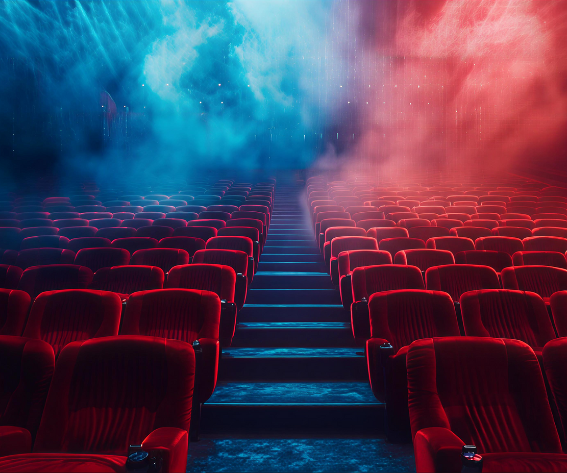
Filmmaking in 2026 feels different the moment you step into it. Anyone who has ever stood on a real film set knows the atmosphere. The warmth of lights, the coils of cable on the floor, the quiet focus of a crew waiting for “action,” and the shared energy of people building something together in one space. For decades, that physical environment defined what making a movie meant.
Today, that environment still exists, but it is no longer the whole story. A growing part of filmmaking now lives inside laptops, cloud drives, virtual workspaces, and massive server farms humming far beyond any studio lot. Cinema has not vanished from the physical world, but it has expanded into the digital one. This shift is not just about new tools. It is changing how films are imagined, constructed, and experienced.
How filmmaking used to work
For most of film history, the set was the heart of production. Even the most technologically advanced movies were anchored in real spaces that people could walk through. Actors moved through tangible rooms, cameras rolled on tracks, and lighting crews shaped real beams of light in real air. Directors interacted with physical space, adjusting walls, props, and blocking in ways that could be seen and felt immediately.
Independent filmmakers were even more deeply tied to real locations. Apartments, warehouses, streets, and parks became canvases for storytelling. Creativity often meant discovering interesting spaces in the world and transforming them into cinematic ones. The set was not simply a background. It shaped performances, guided movement, and grounded the film in something tactile and immediate.
The set was also a social space. Crews bonded over long days, shared problem solving, and collective creativity. A movie felt like a lived experience, not just a finished product.
Why servers matter more than sets now
That relationship began to shift in the early 2020s with the rise of virtual production. LED volumes, real time rendering, and digital environments started to blur the line between what was physically present and what was digitally created. Actors could perform in front of shifting digital landscapes that reacted to camera movement in real time. What once felt experimental gradually became normal.
By 2026, this way of working has moved from novelty to standard practice. Many films are now designed inside software before they are ever shot, and in some cases entire scenes are constructed without traditional cameras at all. Instead of scouting only real locations, filmmakers often explore digital ones. Instead of building physical sets from scratch, they design them in three dimensional space. When changes are needed, they can sometimes be made after the fact rather than requiring costly reshoots.
The center of production is no longer only the soundstage. It is increasingly the server, where footage, assets, and virtual worlds are stored, shared, and transformed. This does not mean filmmakers are disappearing behind screens. It means their creative space now stretches beyond the physical world into a parallel digital one.
Cinema as data
In this environment, movies are no longer just images and sounds. They are vast collections of data. Every frame is information. Every visual effect is built from layers of digital material. Entire worlds can exist as files long before they appear on screen.
This has subtly changed how filmmakers think. A director is no longer concerned only with what looks good in front of a camera. They also consider what can be rendered, simulated, and manipulated later.
Cinematographers still light scenes with care, but they now think about how that light will interact with digital elements in post production. Production designers might sketch ideas on paper, then watch those ideas evolve inside a game engine. Even performances can extend beyond the set through motion capture, digital doubles, and AI assisted enhancement. In many ways, filmmaking has become as much about shaping data as staging drama.
How collaboration has changed
Collaboration has transformed just as dramatically. In the past, making a film usually meant gathering a crew in one place for months at a time. People traveled together, lived together, and built a shared creative rhythm on location.
Today, much of that teamwork happens across distance. Editors work remotely, visual effects artists log in from different countries, and directors review cuts through shared digital platforms. A single film might involve contributors scattered across multiple continents, all working simultaneously.
This has opened powerful new opportunities. Talented artists who could never afford to relocate to major film hubs can now work on large projects from their own homes. Smaller productions can access global expertise that once belonged only to major studios.
At the same time, something has inevitably shifted. The sense of communal energy that once defined life on set is harder to recreate in virtual spaces. Creativity is more connected, but sometimes less communal.
What AI means for filmmakers
Artificial intelligence has also become woven into the process. By 2026, AI tools help generate concept art, clean up audio, enhance images, and assist with visual effects. Some filmmakers embrace this as a way to move faster and experiment more freely. Instead of waiting weeks for early visuals, they can explore many directions in hours.
Others worry that AI could flatten creativity or replace human roles. If a machine can design a set, what happens to production designers? If AI can draft dialogue, what happens to screenwriters? These questions are still unresolved.
Most filmmakers now treat AI as a tool rather than a replacement. It can expand possibilities, but it still requires human judgment, taste, and vision to guide the final result.
Why storytelling still comes first
Despite all the technology, audiences still care most about stories. No amount of stunning visuals or digital realism can replace emotional depth, character, and meaning. In fact, the more powerful the tools become, the more important strong storytelling is.
When anything can be created digitally, what makes a film memorable is not just what it shows, but what it makes the audience feel. A perfectly rendered alien planet means little if the people inside it feel empty. A hyper realistic city means nothing if the story has no soul.
The best filmmakers in 2026 are those who balance technical innovation with human truth.
What the new language of cinema looks like
The language of cinema in 2026 is fundamentally hybrid. A single scene might begin in a real room with real actors, continue inside a virtual environment built on a computer, and then be reshaped later through AI tools in post production.
Collaboration now moves fluidly between physical sets and online workspaces, so films can feel both intimate and globally constructed at the same time. Creativity is less restricted by money or geography than in previous eras, yet it now wrestles with new ethical and artistic questions about authorship, authenticity, and what it truly means to create.
Rather than existing as separate worlds, the physical and digital, the human and technological, have become intertwined parts of one evolving cinematic vocabulary.
From sets to servers, but not away from art
Some people fear that moving from sets to servers will make cinema cold and mechanical. They imagine filmmakers isolated behind screens, disconnected from reality.
But servers are simply tools, like cameras, lights, or editing software. They do not define the art. The artists do. Many filmmakers still shoot on real locations and build physical sets. Many still value the tactile experience of traditional production. The difference is that they now have more creative options than ever before.
Cinema in 2026 is not abandoning the physical world. It is expanding beyond it.
What this means for the next generation
For young filmmakers, this moment is both thrilling and challenging. The possibilities are vast, but the skill set is broader than ever. You now need to understand cameras, editing, digital effects, and sometimes even 3D tools or real time engines.
At the same time, access has never been better. You can shoot on a phone, edit on a laptop, and share your work globally within minutes. The gatekeepers are fewer, but the competition is fiercer. The filmmakers who will shape the future are those who can adapt, experiment, and stay curious.
Final thoughts
From sets to servers, cinema is evolving rather than disappearing. The tools are changing, but the core of filmmaking remains the same. It is still about people, emotions, and ideas. It just travels through new pathways to reach the screen.
The set has not died. It has simply gained a digital counterpart in the cloud. Somewhere between the physical and the virtual, the next great films are already being born.
You may also like:





Leave a reply