
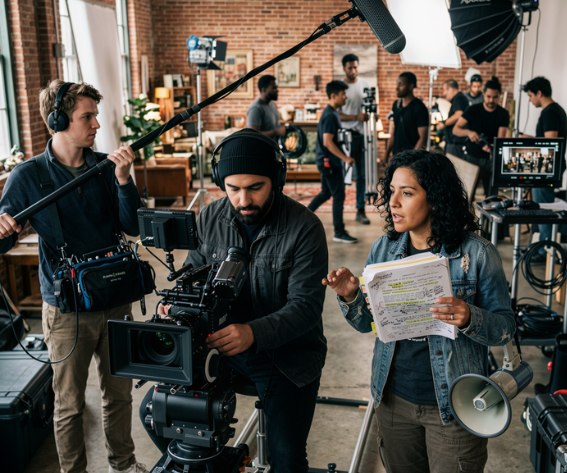
There is a particular kind of magic that happens when you sit in a darkened room, whether it’s a local independent cinema or your own living room, and the screen flickers to life. Lately, I’ve noticed that the line between what we consider a “film” and what we see as an “interactive experience” is getting thinner by the day. We are living through a bit of a creative revolution where the tools used by award-winning indie directors are the same ones being picked up by digital designers to create something entirely new. It’s not just about entertainment anymore; it’s about how we feel when we’re in those worlds.
If you’ve spent any time watching short films on platforms like Vimeo or keeping an eye on The Monthly Film Festival (TMFF), you’ll know that the most powerful stories often come from the smallest budgets. These creators don’t have the luxury of massive CGI departments or Hollywood-style pyrotechnics. Instead, they rely on what I like to call the “Visual Vernacular.” It’s a way of speaking to the audience through shadows, framing, and the very grain of the film itself.
The Visual Vernacular: Making the Most of Every Frame
When a director is working with a shoestring budget, every single shot has to pull its weight. I’ve always been fascinated by how a simple change in lighting can tell you more about a character’s mental state than five pages of dialogue ever could. In many award-winning indie shorts, you’ll see a heavy reliance on “chiaroscuro”—the dramatic use of light and dark. It isn’t just for aesthetics; it’s a tool for emotional storytelling.
Think about a character sitting in a kitchen. In a big blockbuster, that kitchen might be perfectly lit, showing off every expensive appliance. But in a high-concept indie short, the director might keep the character’s face in partial shadow, using a single, harsh light source from the side. Suddenly, it’s not just a kitchen. It’s a space of isolation or perhaps a moment of internal conflict. This kind of framing forces us to look closer and engage our brains to fill in the gaps.
According to cinematography principles found on Wikipedia, the use of “negative space” is another hallmark of this style. By leaving large parts of the frame empty, a filmmaker can convey a sense of loneliness or overwhelming pressure. It is a quiet language that speaks directly to our instincts. We don’t need a narrator to tell us the protagonist is feeling lost; we can see it in the way they are dwarfed by the environment around them.
Sonic Textures: Hearing the Story
If lighting is the soul of indie film, then sound design is surely its heartbeat. Many of us tend to think of film sound as just the dialogue and maybe a bit of orchestral music in the background. However, the most effective independent films often move away from traditional dialogue entirely. They use “Sonic Textures” to build an atmosphere that feels lived-in and real.
We remember watching a short film recently where not a single word was spoken for the first ten minutes. Instead, the narrative was carried by the hum of a distant motorway, the rhythmic clicking of a radiator, and the crunch of gravel underfoot. This isn’t just background noise; it’s a non-verbal narrative. These ambient scores create a physical sensation for the viewer. You don’t just watch the scene; you feel the coldness of the room or the humidity of the air.
Sound designers in the indie world often use “found sounds” to create a sense of authenticity. It’s a technique that avoids the polished, sterile feel of big-budget productions. When you hear the authentic, slightly imperfect sounds of a real environment, your brain relaxes into the story. You stop being a spectator and start being a participant in the atmosphere. This transition from passive listening to active sensing is a huge part of why indie cinema feels so intimate.
The Interactive Shift: Pacing and Engagement
This brings us to a really interesting turning point in how we consume media. We’re moving away from the idea that a film is something you just sit back and watch. The pacing of modern independent cinema is actually starting to redefine how we engage with digital experiences as a whole. There’s a certain tension in a well-made short film—a slow build-up that keeps you on the edge of your seat—that is now being mirrored in the world of gaming and interactive media.
In the past, games were often about constant action, but today, we see a shift towards “cinematic tension.” It’s about the moments between the action. It’s the quiet before the storm. Developers are looking at how indie directors handle pacing—using long, unbroken shots or sudden shifts in perspective—to keep the audience hooked. They are gamifying the very idea of tension itself.
When you think about it, the way we interact with a digital platform isn’t that different from how we interpret a complex film. We look for clues in the environment, we react to sound cues, and we navigate the space provided to us. This crossover is where things get truly exciting. The “passive” viewer is becoming a thing of the past. We want to be part of the world, not just a guest in it.
High-Fidelity Aesthetics in Modern Gaming
This convergence is perhaps most obvious when you look at the production standards of modern online platforms. It isn’t just about big-name titles anymore; even more niche areas are adopting these high-end cinematography and sound design principles. Take the world of iGaming, for instance. If you look at the current state of slots, you’ll find that the level of thematic world-building is staggering.
The developers behind these experiences are clearly taking notes from TMFF award-winners. They aren’t just putting symbols on a reel; they are creating narrative-rich environments with high-fidelity aesthetics. You might find yourself in a Victorian London street, where the lighting is moody and the sound of horse-drawn carriages clatters in the background, or perhaps in a deep-sea exploration where the audio is muffled and atmospheric, mimicking the pressure of the ocean.
This use of narrative-rich reels is a direct descendant of the indie film movement. It’s about using every tool available—visuals, sound, and pacing—to build engagement. When the production quality is this high, the line between “playing a game” and “experiencing a story” starts to disappear. It shows a level of respect for the user’s intelligence and their desire for a cohesive, well-crafted world.
A New Creative Language
So, where does this leave us? I think we’re entering an era where the medium matters less than the message and the mood. Whether it’s a five-minute short film about a quiet moment in a café or a digital experience that uses cinematic techniques to build suspense, the goal is the same: to create a genuine emotional connection.
The fluid boundary between film and interactive media is a playground for creators. We’re seeing filmmakers experiment with interactive narratives, and game designers becoming masters of cinematography. It’s a wonderful time to be a consumer of culture because the quality is rising across the board. We are no longer limited to one-way storytelling.
Many of us have experienced that feeling of being completely lost in a well-crafted world, and as these technologies and techniques continue to blend, those experiences are only going to become more frequent and more profound. The lessons learned on the festival circuit—about the power of a well-placed shadow or the impact of a silent moment—are now the building blocks of the entire digital landscape.
It’s worth remembering, of course, that while these digital worlds are captivating, we should always enjoy them responsibly. Much like a good film, they are there to provide a bit of wonder and a change of pace from the everyday.
As we look forward, we’re excited to see how this convergence continues. Will we eventually reach a point where we can’t tell the difference between a film and a game? Maybe. But as long as the focus remains on high-quality storytelling and authentic human emotion, I think we’re in for a very interesting ride. The boundary isn’t just fluid; it’s practically gone, and in its place is a new, exciting way of sharing stories that we can all be a part of.
You may also like:





Leave a reply