
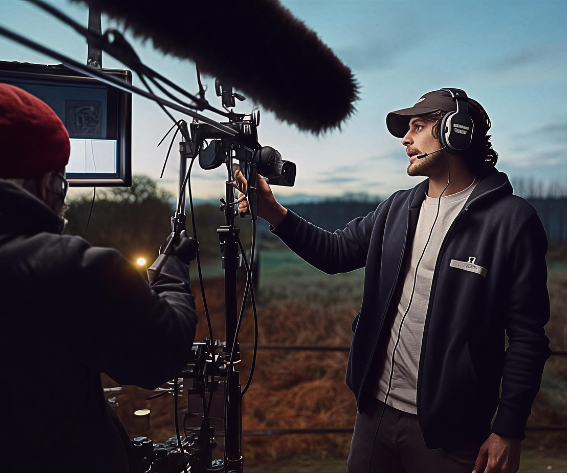
New filmmakers often believe sound quality comes from buying the right microphone. They compare shotgun models, read technical specifications, and watch hours of reviews hoping a better piece of gear will automatically produce professional audio. In reality, the biggest difference between amateur and professional dialogue is not the microphone model. It is where the microphone is placed.
Most bad film sound comes from distance. When the mic sits too far away, the room becomes louder than the actor. Reflections, air, and background noise begin to overpower the voice. The audience hears space first and performance second, which instantly feels artificial even if they cannot explain why.
You can hear this problem constantly in student films and low budget productions. Dialogue sounds hollow and detached, as if the actor is standing in another room. Conversations online sometimes drift into unrelated subjects, yet the real issue remains basic recording technique. A properly placed affordable boom mic will outperform a poorly placed expensive one almost every time.
Sound Is Controlled by Ratio
A microphone captures everything at once. It records the voice, but it also records the environment surrounding that voice. The key to clean dialogue is not eliminating background sound but controlling the balance between voice and environment.
When the microphone moves farther from the actor, the voice level drops quickly while the room level drops much more slowly. The recording therefore becomes dominated by reflections. No equalizer or noise reduction tool can fully restore clarity because the clarity was never captured in the first place.
Professional production sound mixers think in ratios. Their goal is to make the actor significantly louder than the space. Placement is the only reliable way to achieve this consistently. Gear quality helps refine the signal but cannot replace proximity.
The Ideal Boom Position
The correct boom position is usually just above the actor’s head, angled toward the mouth, and placed as close as possible without entering the frame. This location captures clear articulation while avoiding chest resonance and clothing noise. It also keeps the microphone aligned with how humans naturally project speech forward and slightly upward.
A boom operator constantly adjusts to performance movement. When an actor leans back, turns their head, or lowers their chin, the mic must subtly follow. The work is less about holding a pole and more about tracking a voice in three dimensional space. Good operators anticipate movement rather than reacting to it.
If the mic becomes visible, it is too low. If the dialogue sounds roomy, it is too high or too far. The balance is delicate and requires coordination between camera framing and sound recording.
Why Expensive Microphones Do Not Save Bad Placement
High end microphones provide lower self noise and smoother tone, but they also reveal acoustic problems more clearly. A premium shotgun placed too far away records a pristine version of bad audio. You hear every echo in perfect detail.
Many beginners expect directional microphones to isolate voices across a room. Directionality reduces side noise but does not defeat physics. Reflected sound still reaches the microphone from every surface. Only distance changes the relationship between direct voice and reflections.
This is why professionals prioritize boom position before choosing the mic model. A modest microphone positioned correctly produces usable dialogue, while a luxury microphone placed poorly produces unusable dialogue.
Real World Example: Two Setups, Two Results
Imagine the same scene shot in a living room with hard walls and a low ceiling. Setup A uses a premium shotgun but keeps it safely high to avoid dipping into frame. Setup B uses a midrange mic but places it just out of frame, pointed directly at the actor’s mouth.
Setup A sounds roomy, thin, and reflective because the microphone is hearing the room nearly as loudly as the performance. Setup B sounds intimate and controlled because the direct voice dominates the reflections. The viewer will describe Setup B as “more professional” even if they cannot name why.
That is why the smartest “upgrade” is not another microphone. It is rehearsing boom placement with the camera team, marking actor positions, and training an operator to ride the frame edge with confidence. The same logic applies in other industries too, where placement and context matter more than raw specs, and where you can find the best platforms offering casino push gaming titles with generous bonuses.
Working With the Camera Department
Great production sound depends on cooperation. The camera operator frames the shot while the boom operator rides the edge of visibility. Communication determines whether the microphone can stay close enough.
Wide lenses make boom placement harder because the frame expands upward. Tight shots make it easier because the microphone can sit closer without appearing. Experienced crews discuss shot sizes before rolling so the boom operator knows how aggressive they can be.
Sometimes a slight framing adjustment dramatically improves sound quality. Moving the camera a few centimeters down can bring the microphone much closer to the actor. These compromises often save hours in post production.
When Lavaliers Are Not the Solution
Wireless lavalier microphones are helpful tools but not replacements for a boom. They sit on clothing, which introduces fabric noise, tonal inconsistency, and an unnatural proximity effect. Lavs also capture chest resonance rather than the natural projection of speech.
Boom microphones preserve spatial realism. They allow actors to move freely without sounding mechanically attached to their wardrobe. The voice exists in the same space as the image, which the audience subconsciously reads as truthful. Lavaliers instead pin the voice to the body. Every head turn changes tone, every jacket rub becomes a problem, and the performance starts to feel recorded rather than observed.
This does not mean lavaliers are useless. They are essential when the frame is extremely wide, when ceilings are too high for a boom, or when movement is unpredictable. The professional approach is usually boom first, lav second. The boom provides the natural sound while the lav serves as protection against unusable takes.
Movement Changes Everything
Actors rarely stand still. They lean, pace, turn, sit, and stand again. Each movement alters the relationship between mouth and microphone. A static boom position quickly becomes incorrect once blocking evolves.
Good boom operation is choreography. The operator mirrors the actor’s motion with subtle adjustments, keeping consistent distance and angle. When done well, the audience never notices because the voice remains stable even though the performer moves constantly.
Beginners often prioritize avoiding the frame over maintaining distance. The result is safe but distant audio. Professionals accept that the boom lives on the edge of the shot. They rehearse the movement so the microphone can stay close without appearing.
Rooms Are Louder Than You Think
Hard surfaces reflect sound far more than most filmmakers expect. Bare walls, floors, ceilings, windows, and tables all bounce dialogue back into the microphone milliseconds after it leaves the actor’s mouth. These reflections smear clarity.
Moving the mic closer reduces reflections dramatically because the direct voice becomes dominant. Moving it farther away does the opposite. No microphone brand changes this relationship. Only position does.
This is why experienced crews treat location choice and boom placement as one decision. A smaller controlled room with a close boom often sounds better than a large beautiful space recorded from a distance.
The Cost of Fixing It Later
Editors often receive dialogue that sounds echoey and distant. They attempt noise reduction, equalization, and artificial reverb matching. These tools can improve listenability but rarely restore presence. The performance still feels separated from the image.
Automated dialogue replacement is the final rescue, but it is expensive and time consuming. Actors must recreate emotional performances in a studio while matching lip sync. Even when done well, subtle authenticity is lost.
Five extra seconds spent lowering the boom on set can prevent hours of repair and preserve the original acting moment.
Training Your Ear
Learning placement is less about memorizing measurements and more about recognizing sound quality instantly. Record test lines while moving the microphone closer and farther away. Listen through headphones, not camera speakers. The difference becomes obvious very quickly.
You will notice that clarity increases faster than volume. The voice does not just get louder. It becomes sharper, more present, and more intimate. That change is what audiences perceive as professional.
The Real Upgrade
Filmmakers often upgrade cameras before improving sound technique. Yet viewers tolerate imperfect images surprisingly well as long as they understand dialogue. Clean audio signals competence and intention more strongly than resolution or dynamic range.
The most valuable investment is practice. Practice coordinating with the camera operator. Practice rehearsing blocking. Practice riding the frame line confidently. A modest microphone in skilled hands will outperform premium gear used carelessly.
In the end, microphones capture what placement allows them to hear. Price influences polish, but distance determines whether the performance exists at all.
You may also like:






Leave a reply