
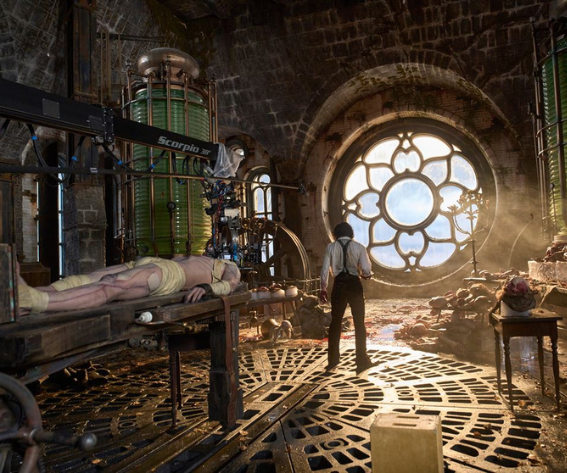
Guillermo del Toro’s Frankenstein walked away from the 98th Academy Awards with three Oscars, and the one for Best Production Design may have been the most deserved. Production designer Tamara Deverell built a world where stone, iron, and decaying copper carry moral weight. The set is not just a background but an argument.
The film’s stylistic language goes far beyond period accuracy. Deverell and del Toro treated every interior as a psychological portrait. Anyone who has ever admired a piece of furniture built to endure, like a finely crafted Italian sofa, will recognize something in Frankenstein’s estate: materials and furniture are chosen for what they reveal about the people who inhabit the spaces, not for how they look.
The Loop Between Life and Death
Deverell’s most recurring design choice is the circular motif, which is pressed into the floors, windows, and structural elements throughout the film. They are anything but decorative. As she has explained in interviews, these shapes represent the circle of life and death, and the endless loop between them. Del Toro embedded this motif everywhere, from the giant Medusa head dominating one wall of Victor’s lab to the massive circular window facing it on the other side; a formal obsession that gives the interiors their strange, almost liturgical coherence.
The film’s Gothic vocabulary, rooted in Victorian wrought iron and dark, dense wood, pushes the aesthetic into territory that rhymes, perhaps unexpectedly, with certain strands of contemporary furniture design. Brands like Giorgetti have long built a language around rounded forms, rich-grain wood, and an organic warmth that never tips into sentimentality. The materials, much like del Toro’s sets, communicate something that sits well beyond mere function.
When Furniture Becomes a Social Signifier
Some of the most striking still images from the film’s sets show deep-button upholstered armchairs, chesterfield-adjacent pieces anchoring the more domestic interiors of the Frankenstein family home. Del Toro used them deliberately: in a story about the collision between aristocratic privilege and moral catastrophe, furniture becomes a social signifier.
Positioned beneath a vaulted ceiling or beside a fire, the tufted leather chair isn’t about comfort; it’s about authority, lineage, the quiet performance of power. The Chesterfield silhouette remains one of the most charged pieces in interior design precisely because it carries that same fundamental ambivalence: luxury that knows it is luxury, and doesn’t apologize for it.
In Frankenstein, Every Object Has a Moral Intent
The most memorable set piece in the film isn’t a room; it’s a surface. Victor Frankenstein’s laboratory table, the Y-shaped structure on which the Creature is assembled from salvaged human remains, is equal parts medical instrument and altar.
Deverell built it inside a space dominated by marble floors, a custom metal spiral staircase, and glass battery towers, each standing fifteen feet tall and glowing green. Solid wood appears throughout the lab in structural scaffolding and heavy cabinetry, aged, dense, and rigorously functional. There’s nothing decorative about any of it. This is furniture with a job to do, and the moral weight of that job is fully encoded in the material itself.
Objects in a well-designed space are never merely things; they carry the logic and intention of whoever placed them there, and in del Toro’s world, that intention is always moral.
What Film Sets Teach Interior Designers
Production design operates under constraints that residential or commercial interior design rarely faces: every element must read on camera, in motion, under controlled light. This forces a clarity of intention that is genuinely instructive.
Deverell built Frankenstein’s world by studying the Hunterian Museum in London, scouting Scottish castles, and obsessively sourcing period-accurate scientific instruments, all to produce interiors that feel lived in rather than dressed up. The result is something most designed spaces consistently fail to achieve: rooms that communicate, without any caption or explanation, exactly what kind of person lives inside them.
Coherence doesn’t come from matching finishes or curating for a mood board. It comes from understanding what a space is truly for, who occupies it, and what they actually believe about the world they inhabit.
The Gothic has always been about excess in service of meaning, and del Toro’s Frankenstein makes that argument more vividly than most design schools could ever manage.
You may also like:







Leave a reply