
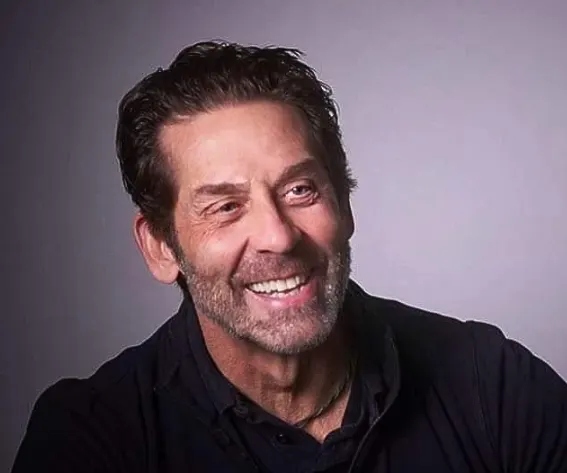
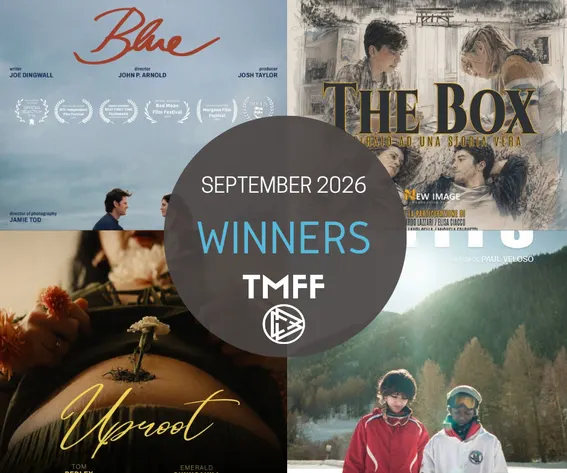
What does it take to truly see ourselves through the eyes of someone who believes in us? Our latest winner, 'Blue', explores this question through the relationship between Sam, an actor, and Kate, an artist, as they walk through Edinburgh, revisiting memories and confronting uncertainties about their relationship. An intimate story about love, identity, creativity and self-worth, 'Blue' celebrates the people who help us recognise our own potential. Winner of Film of the Month, Director of the Month, Screenwriter of the Month, Actor of the Month and Actress of the Month, the film impressed us with its emotional depth and heartfelt performances. We spoke with director John P. Arnold about bringing the story to life, working with his cast, and the importance of human connection both on and off screen.
TMFF: Congratulations, John! Blue had a fantastic month at TMFF, winning five awards, including Film of the Month, Director of the Month, Screenwriter of the Month, Actor of the Month and Actress of the Month. How does it feel to see the film and the performances at its heart receive such recognition?
JPA: All at team BLUE are absolutley blown away at this unbelievable response from TMFF !! We are all so sincerely grateful to receive so much recognition for the film. I think it is truly reflective of just how much heart and soul went into the making of BLUE and truly how each and everyone person contributed to the project in such an amazingly high standard. It was from the very start a true team effort and all are so deserving of being recognized for their part in the film.
TMFF: At its core, Blue is a story about identity, self-worth and the influence we have on the people closest to us. What initially drew you to Joe Dingwall's screenplay, and what made you want to tell this particular story?
JPA: Joe and I have had the priviledge to work with one another within the industry as actors/performers, so when he approched me with his driving desire to make this film, I knew this would be a project that was deeply personal to him and one that he was extremely committed to, which automatically makes life a lot easier for me as a director !! So, when I read the script, it quickly became clear that it was not only a story that Joe wanted to tell, but it also was a story that deserved to be shared with others as I felt it would be very meaningful and resonate with audience members who experienced the film. And that is such an amazing,priveleged thing we get to do in the arts; create for self and for others ! The vunerability that is required to bare oneself is one of the prerequisites to making an exceptional film, or any art I think. To selflesly share a story that examines one's indentity and self worth in how we releate to our surroundings is a story that I wanted to also wanted to invest my creative time with.
TMFF: The film explores something many creative people can probably relate to: being able to recognise talent and potential in others while struggling to see those same qualities in ourselves. Is that something you have encountered in your own career as an actor and director?
JPA: I'm not exaclty sure why, but I believe we lose the ability, somewhere along this journey of life, to see ourselves as we truly are. We lose sight of our authentic selves and the ability to love ourselves in many ways. It is then that we easily defer to others and rather put everything into them, loosing ouselves little by little in the process. We compare ourselves to others, rather than identify with others, and in doing so we become lost. We elect to be involved in our lives by believing only in others, and conveniently putting self aside. So, yes, I have absolutley encountered such stuggles in my creative life which is also another reason why I wanted to be a part of BLUE's creation on film. Becuase the best way I know to cultivate a real belief in oneself is to show up for your life no matter the consequences, dispelling fear by taking the action that so often your mind tells you that you are not ready for. It's learning how to say, "yes", even when afraid to do so.
TMFF: Both lead performances are central to what makes Blue so emotionally engaging, and we're delighted to have recognised them with our Actor and Actress of the Month awards. What was it like working with the two actors, Joe Dingwall and Jade Sylvester, and how did you go about building that sense of intimacy and authenticity between Sam and Kate?
JPA: I could not be happier for our two lead actors, Jade Sylverster and Joe Dingwall to be awarded Actress and Actor of the Month from TMFF !!! Both are exceptional actors that fully committed themselves to the entire rigorous process from beginning to end !! The talent, energy, insight, creativity, and humor that these two brought to rehearsals and to the set was beyond what you could ask for as a director. I have always said that they key to any great actiong performance is sincerity. We're not meant to "see" the script, but rather experience the story. The narrative of BLUE unfolds beautifully in the hands of these very capable actors as they crafted their parts in such an articulate and meaningful manner. The relationship between Sam and Kate has many levels and achieving those dynamics in performacne was essential to capture the insight of what these characters were living in the film . To quote one of my most favorite acting theorists, " Creating relationship is the heart of acting". They way Sam and Kate intimately related to one another, moment by moment, allows us to follow them on this jouney of discovery of themselves and of one another. We witness the authentic interchange of the characters and how the dramatic conflict of fear, doubt and insecruity can wreak havoc in see ourselves and relate to others, especialy to those whom are closest to us.
TMFF: Edinburgh feels like an important part of the film's identity, rather than simply a backdrop. With Joe's personal connection to the city and its locations, how did you approach bringing Edinburgh to the screen, and what do you think the setting adds to Sam and Kate's journey?
JPA: Edinburgh is the not- so- silent "other lead character" in the film! We could have filmed anywhere, in theory, to make BLUE. But in order for the film to be as effective as it is, there was no other option but to film in the beautiful, majestic city of Edinburgh. The city and it's memories are like emotional landmines for Sam and Kate. Peoples,places and things within Edinburgh hold so much meaning and feelings for these two characters that it was crucial to the film to see and understand how these exact elements of the city shaped their lives.
TMFF: Blue was a genuinely independent production, bringing together Scottish creatives and relying largely on Joe's own funding, alongside support from Creative Scotland. What were the biggest challenges of bringing the project to life, and did working within those limitations influence any of your creative decisions?
JPA: The biggest challenges in creating film with such a tight budget is always a lack of creative freedom in a sense. You instinct is to want to do more and to give more !! You want to have access to the locations you have in mind, you want to have all of the state of the art equipment possible, you want to hire as many people as you want, and you simply want to make life easier for all who are on the project !! Don't get me wrong, we had exceptional support from contributors, Creative Scotland, and the many selfless people and businesses that either voulnteered their time or worked with us on the budget we had. But life certainly would have been a bit less hectic with a bigger budget!! But that is the nature of the beast, isn't it ?? That is also what makes great a truly indie film !! The creative chaos that insues witin such confines actually allows you to work in an incredibly innovative manner. You find things on set that you would'nt otherwise if it were all smooth sailing !! As the old adage goes,"Necessity is the Mother of Invention" blissfully applied throughoht this process. !! We faced with a problem, we were solution oriented and motivated to create within our limitations rather just give up !! So, in the end, we turned our limitations inot assest to create the film we wanted.
TMFF: Was there a particular scene, performance or moment during production when you felt that everything had come together and you had captured what Blue was really about?
JPA: It is very difficult to pin point a particular scene that represents the essence of the entire film as BLUE is episodic in nature. The story of Kate and Sam is revealed continuously, building and relying upon each shot to assemble the whole of the narrative. We wanted to have each scene be as powerful as the next whilst building this subtle crescendo throughout. Each part of the jounery of these two characters makes up the significance of the ultimate outcome of the film, so by the time you reach the end, you are invited to go right back to the beginning to see one of the key messages of the film; that the peace and truth of ourselves that we so often seek externally, exists within us all the time - but we simply cannot see it , until we see it.
TMFF: What do you hope audiences take away from Sam and Kate's story, particularly when it comes to their own relationships and sense of self-worth?
JPA: It was one of the main goals and objectives of the film to lift the veil of the false belief that we maintain about ourselves. Sam is plagued with a false sense of self and becomes excessively and uneccesarily focused on Kate at the expense of himself. The irony here is that Kate not only does not need Sam's additonal attention in the way he thinks she does, but she is constanly and in light of her own journey, encouraging him to, yes love and support her, but to also be able to do the same for himself. Kate has been down the "path" much further than Sam and can see many things that Sam simply can't quite yet. So one of the major take aways is invite people to challenge that pervasive limited sense of self and that cultivating a true belief in self is not a selfish act, but one of the most important things we can in our develpment of self
TMFF: Finally, having worked across so many different areas of the industry, from acting and coaching to directing, where would you like to take your filmmaking next? Are there any new projects or stories you're currently developing?
JPA: I am honestly blessed to be actively working accross so many different areas of the entertainment industry !! My intentions as an artist when I first began were to be involved in as many areas as I could including theatre,film, t.v., radio, voice over, singing, teaching, coaching, and directing. I wanted to do it all ...and by doing it all I feel I stay on the cuttind edge of what the creative arts has to offer ...and also, it keeps me from being pigeonholed into any one area of the industry. All of this results in keeping on my toes and very involved, allowing me to enjoy my work as much as possible. Most all of my next projects are returning to being in front of the camera as a performer, but there a number of professional actor's reel scenes that I will be directing as well as a music video that is on the horizon. As for the next film project, I would love to again jump back into the short film genre, although if offered a feature film or t.v, would not hurt my feelings at all !!
TMFF: Thanks so much for your time, John. It was a pleasure to discover Blue and the heartfelt story behind it. Congratulations again to you and the entire team on an exceptional month at TMFF, and we look forward to seeing what comes next!
JPA: And, once again, thank you on behalf of all of us at BLUE for the amazing recognition of our work !! We are humbly grateful for your chososing us all !!
Comments
No comments yet. Be the first to share what you thought.