
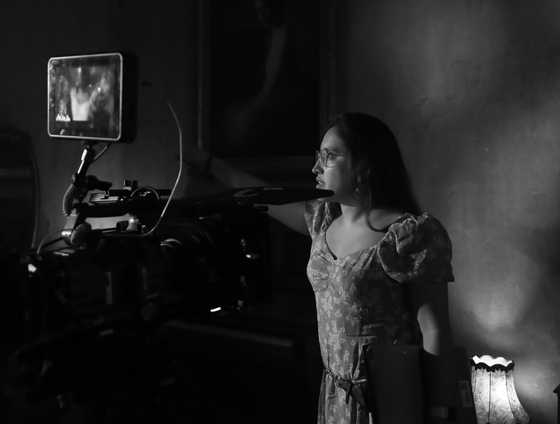
After an outstanding run at The Monthly Film Festival, Abril Andrea Arnauda Appel’s ‘SHE WAS‘ took home multiple awards, including Film of the Month and Director of the Month. A haunting and emotionally driven short, the film explores themes of memory, loss, and the silencing of women’s stories. We spoke with Abril about the inspiration behind the film, its powerful message, and the responsibility of telling stories rooted in real-life experiences.
TMFF: Congratulations on the incredible success of SHE WAS, Abril – winning Film of the Month, Student Film of the Month, Director, Screenwriter, Actress, and Audience Award is no small feat! How has the reaction been so far?
AA: Thank you so much for the congratulations. We never expected She Was to have this level of success at the festival. The overall reaction has been one of deep gratitude—toward the audience who voted for us for the Audience Choice Award, and toward the jury for selecting us across so many categories. It’s overwhelming. As soon as I found out, I shared the news with all the nominees and the rest of the crew. We couldn’t believe it, and we were so excited to share it with our families, friends, and on social media.
TMFF: SHE WAS is a powerful and haunting title. Can you tell us what first inspired this story?
AA: A haunting reminder stayed with me. When I moved to Berlin, I kept thinking about cases of missing people—both here and in Mexico. I couldn’t accept how easily these stories become silenced or forgotten, and I felt I couldn’t ignore it as a Mexican migrant. During my master’s, we were told how important our final project would be, and I knew this had to be the story. I had been exposed to countless news stories in Mexico about women who disappear and are quickly forgotten, and I experienced a similar silence when I arrived in Berlin—it felt as if nothing had happened. The case of Maria Fernanda Sánchez Castañeda, who disappeared and died in Berlin in July 2023, deeply stayed with me. The conflicting narratives around her death led me to explore both perspectives, while giving space to the version that is often dismissed.
TMFF: SHE WAS is inspired by a real-life story that closely parallels your own experiences. What compelled you to tell this story?
AA: It’s unsettling to realize that someone you relate to or someone who shares aspects of your life, could experience something so terrible. It inevitably brings up that question: what if it had been me? That feeling is what drew me to this story. I’m interested in telling stories of those who can no longer speak for themselves, especially women—their silences, struggles, and resilience. She Was is inspired by a young woman from my hometown in Mexico, with whom I shared certain parallels. Rather than focusing on the morbidity of her case, I wanted to center her humanity—honoring her memory while also acknowledging the many women who are still missing or unheard, and offering a sense of reflection and, hopefully, some peace.
TMFF: You’ve spoken about being drawn to stories of those who cannot speak for themselves. What does that responsibility mean to you as a filmmaker?
AA: I believe it’s a huge responsibility to act as a voice or facilitator for these stories—to create a space where they can be heard. Even though this is not a documentary, it carries a strong ethical responsibility to remain truthful to its values and respectful to the people it represents, both on and off set. There is a very fine line between exploiting these stories and helping them grow and resonate. I try to approach every story with sensitivity, giving special care to the people who inspire them, as well as to the fictional characters I create. I build them carefully with the actors, protecting their emotional truth.
TMFF: The story also connects to the wider issue of femicide and unresolved cases. How important was it for you to bring this context into the film?
AA: Part of what pushed me to tell this story was the numbness that comes after reading yet another article or watching another news report about a disappearance or death. In Mexico, we are very used to sensationalist news, and these stories have become normalized. Yet, around 14 women disappear every day. And this is not only in Mexico, women disappear and are killed all over the world, often simply for being women. Some might think, “this doesn’t happen in Europe,” and while I do feel a difference living here, the truth is: it has already happened. It was very important for me not to base the film on a single case, but to draw from many, from different women, including those close to me: my mother, my grandmother, my friends. With the hope that none of them will ever have to go through this.
TMFF: You’ve mentioned wanting to focus more on emotion than morbidity. How did you approach that balance in the storytelling?
AA: I had to clearly define a boundary between documentary and fiction, including open conversations with the family involved as part of my ethical responsibility. While I aimed to keep the core event close to reality, the rest of Katty’s inner world was inspired by other women. I chose to introduce the death and both versions of it early in the film, but to give the second version a more emotional and introspective treatment. The final scene carries the emotional weight and offers resolution and peace within a fully fictional, almost fantastical environment—one inspired by the Mexican perspective on death, where reunion in the afterlife is possible, and where the dead are remembered with love, respect, and open arms. I also valued having another perspective. My co-writer, Gabby Reyes, helped create distance from the story and brought a fresh point of view. She encouraged us to deepen the second version, focusing more on dialogue and on giving Katty a voice, allowing her to be heard.
TMFF: Marilyn Uribe, your lead actress, delivered an award-winning performance. What was your collaboration like in developing the character?
AA: We had several rehearsal sessions, both online and in person, where we read scenes and reflected on Katty and her world. Marilyn was wonderful to work with—her questions were always precise, and she came very well prepared. Her personality is very different from Katty’s, which made her performance even more impressive. The way she acts with her eyes is remarkable. On set, she needed very little direction—she understood everything almost immediately. I think we both brought parts of ourselves into Katty, as migrants experiencing similar emotional challenges, including migration-related depression and the complexity of adapting to a new culture. Marilyn brought incredible layers, sensitivity, and trust to the role. I’m very grateful to her, and congratulations to her as well.
TMFF: What do you hope audiences reflect on after watching SHE WAS?
AA: I invite audiences to question their perspectives, form their own opinions, and reflect on the importance of giving a voice to those who can no longer tell their own stories. I also want to tell a story that is felt, one that offers emotional release. I hope it encourages reflection and serves as a reminder that these women will not be forgotten. Most importantly, I hope it breaks that sense of numbness we develop when consuming these stories as just another piece of news, and reminds us that these are human lives.
TMFF: Are there any future projects you’re working on that continue exploring similar themes?
AA: I’m currently finishing post-production on my newest short film, Promised Day, a drama-dance piece in which two women—embodying the past and the future—confront a shared trauma through movement, transforming it and finding freedom in the present. The film explores memory and its psychological impact, identity as something fragmented and evolving, inner conflict, the relationship between past, present, and future, and ultimately, emotional release, transformation, and healing through movement.
TMFF: Thank you for your time, Abril! We’re looking forward to seeing more of your work.
AA: Thank you so much for having me, my crew, and my film at The Monthly Film Festival. 🤍
You may also like:






Leave a reply