
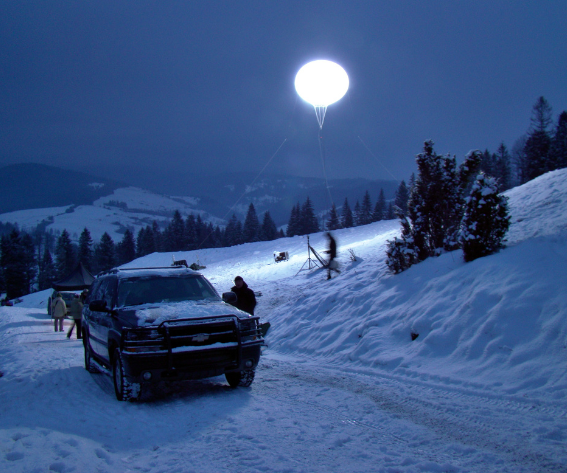
Night scenes are often treated as a simple technical problem: make the image darker and the audience will understand that it is nighttime. That approach sounds logical, but it can quickly produce muddy shadows, invisible performances, noisy footage, and images that are difficult to grade. Some of cinema’s most convincing night scenes are actually filled with carefully controlled light. The trick is not making the frame objectively dark. It is creating the feeling of darkness while still giving the audience enough visual information to understand the scene.
Darkness Is a Feeling, Not an Exposure Setting
When we walk through a city at night, we rarely experience complete darkness. Streetlights illuminate sidewalks, headlights sweep across buildings, signs glow above storefronts, and light escapes through windows. Even in rural environments, there can be moonlight, porch lights, flashlights, fires, or distant artificial sources. Our eyes constantly adjust to these changes, which means our perception of nighttime is more complicated than simply seeing less light.
Filmmakers can take advantage of this. Instead of underexposing the entire frame, they can create darkness through contrast. A character’s face might be clearly visible while the room behind them disappears into shadow. A street can contain bright pools of light surrounded by areas of near-black. The audience reads those contrasts as nighttime even when important parts of the image are properly exposed.
Give the Light a Reason to Exist
One of the easiest ways to illuminate a night scene without destroying the illusion of night is to motivate the lighting. Motivated lighting means that the audience understands, consciously or subconsciously, where the light is supposed to be coming from. A bedside lamp, refrigerator, phone screen, passing car, storefront, television, or streetlight gives the cinematographer permission to illuminate the scene. Online platforms use a comparable principle when they draw attention to a particular feature or promotion. A highlighted offer such as the JavoWin Bonus is designed to be immediately noticeable within the surrounding page, while cinematographers use practical lights and brighter areas of the frame to establish an equally clear visual hierarchy.
This hierarchy is especially useful in night cinematography because the brightest part of an image naturally attracts attention. A filmmaker can place a lamp beside an actor, allow a shop sign to illuminate a face, or use headlights to briefly reveal important details. It is similar to how the JavoWin Bonus gains prominence through its presentation relative to the information around it. In a film frame, controlled differences in brightness can guide the viewer toward a character, object, or action without requiring the entire environment to be brightly exposed. The result can feel convincingly dark while keeping the important storytelling information visible.
Let Something Be Black
A common mistake when shooting at night is trying to preserve detail everywhere. Filmmakers become nervous when a corner of the frame disappears or when the background becomes difficult to see. They start adding fill lights until every wall, object, and actor is visible. Eventually, the scene technically takes place at night but visually resembles a softly lit interior during the day.
Night cinematography benefits from selective information. Some areas of the image can disappear completely. In fact, those areas can make the illuminated portions of the frame more effective.
Think about a character standing underneath a streetlight. The audience does not necessarily need to see every building behind them. Allowing the background to fall into darkness isolates the character and creates depth. Similarly, a face can move partially into shadow without becoming unreadable. The viewer only needs enough information to understand the expression and follow the performance.
This is where lighting becomes storytelling rather than correction.
Use Contrast Instead of Simply Lowering Exposure
There is a significant difference between a dark image and an underexposed image. A dark image can contain strong blacks, controlled highlights, readable skin tones, and deliberate separation between subjects and backgrounds. An underexposed image may simply lack enough information.
Instead of reducing exposure across the entire scene, filmmakers can build contrast inside the frame. Imagine a kitchen at midnight. Rather than shooting the room several stops darker, you might allow the refrigerator interior to illuminate the actor while the rest of the kitchen falls away. The refrigerator becomes the brightest part of the composition, immediately telling the viewer where to look.
The same approach works outdoors. A wet street can reflect headlights and storefronts, giving the cinematographer small areas of brightness while maintaining large regions of darkness. Fog can catch distant lights. Windows can create geometric patches of illumination. Even a small practical source can become visually significant when everything surrounding it is darker.
Color Can Tell the Audience It Is Night
Brightness is only one cue audiences use to understand time of day. Color is another.
Cooler tones are commonly associated with nighttime, particularly blues, cyans, and cooler neutral colors. This convention is so familiar that filmmakers can sometimes maintain surprisingly bright exposure while still communicating night through color temperature.
That does not mean every night scene should be blue. In fact, mixing color temperatures can often produce richer images. Warm interior light against a cooler exterior immediately separates two spaces. Sodium-colored streetlights can contrast with cooler ambient light. Neon signs can introduce saturated reds, greens, or magentas without making the environment feel like daytime.
Color provides another tool for suggesting darkness without sacrificing visibility.
Think About the Background First
When lighting actors, it is tempting to begin with the face. For night scenes, however, considering the background first can produce stronger results.
Ask what should be visible behind the character. Is there a distant streetlight? A window? A hallway? A city skyline? A practical lamp?
Once the background has been established, the subject can be lit relative to it. This helps prevent the common situation where an actor looks beautifully illuminated but appears disconnected from the environment.
Separation is particularly important at night. A dark-haired actor wearing dark clothing can disappear against an unlit background. A subtle edge light, brighter wall, distant practical, or small shift in blocking may be enough to define their silhouette.
Night Lighting Should Support the Emotion
Technical realism is not always the goal. The lighting should ultimately support what the scene is trying to communicate.
A romantic night scene might use soft sources, glowing backgrounds, and gentle falloff. A thriller might leave large sections of the composition unresolved. A comedy could be brighter and flatter because clearly seeing the actors’ reactions matters more than creating ominous shadows. Horror might deliberately prevent viewers from seeing what exists beyond a character.
The same location can therefore require completely different night lighting depending on the story.
This is why copying a lighting setup without understanding its dramatic purpose rarely works. A cinematographer is not simply recreating nighttime. They are deciding what nighttime means in that particular moment.
Darkness Works Best When the Audience Can Still See
A successful night scene does not need to prove how little light was available on set. It needs to convince the audience that the characters inhabit a world where it is night.
That distinction gives filmmakers much more freedom. Faces can remain readable. Highlights can be bright. Windows can glow. Streets can reflect light. Practical sources can shape the composition. Entire sections of the frame can disappear when doing so strengthens the image.
Instead of asking, “How dark should this scene be?” a more useful question is, “What should the audience be able to see?”
Once that decision is made, darkness becomes something filmmakers can shape rather than something they simply impose on the image.
Image source: PickPik
You may also like:






Leave a reply