
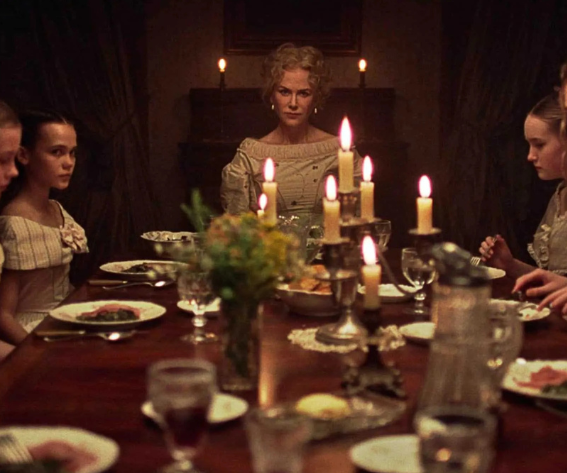
Dinner table scenes look deceptively simple. Put a few actors around a table, serve some food, point the cameras at them, and let the conversation unfold. Compared with a car chase, a crowded street sequence, or an elaborate tracking shot, there seems to be very little that can go wrong. Yet for directors, dinner scenes can be among the most complicated sequences in a film. They combine demanding blocking, continuity problems, performance timing, camera coverage, and visual storytelling within a remarkably confined space.
Part of the difficulty comes from the fact that everyone is sitting down. Directors normally have movement available to express changes in relationships. A character can cross a room, move closer to someone, retreat into the background, or physically separate from the group. Around a dinner table, most of those possibilities disappear. Characters occupy fixed positions for long stretches, forcing the director to communicate shifts in power and emotion through smaller choices such as posture, eye contact, gestures, framing, and the timing of cuts.
There is also the problem of geography. With several people facing different directions around the same table, maintaining clear screen direction becomes surprisingly complicated. The director and cinematographer have to establish where everyone is sitting and make sure the audience understands who is looking at whom. Crossing the 180-degree line carelessly can suddenly make two characters appear to be looking in the same direction instead of at each other. A seemingly minor camera placement can therefore make an otherwise straightforward conversation visually confusing.
Dinner scenes also tend to contain distractions that other dialogue scenes do not. Plates, glasses, cutlery, serving dishes, and food all become part of the performance. A character might pour wine while discussing money, push a plate away after hearing uncomfortable news, or casually talk about a sweepstakes casino while another character reacts from across the table. Each action gives the scene texture, but it also creates another detail that must remain consistent across different takes and camera angles.
Continuity Becomes a Serious Problem
Food is one of the biggest continuity challenges on a film set. Imagine an actor cutting a steak during the master shot. By the end of the take, half of it has been eaten. The production then moves to a close-up that represents the beginning of the same conversation. The steak suddenly needs to look untouched again. Multiply that problem by five actors, several dishes, drinks, napkins, and dozens of takes, and the complexity becomes obvious.
Actors also need to reproduce their movements with unusual precision. If someone takes a drink immediately before delivering a particular line in the wide shot, that action should usually happen at roughly the same moment in the close-up. Otherwise, the editor may struggle to cut naturally between angles. Script supervisors carefully track these details, but the actors and director still have to build performances that remain emotionally convincing while respecting continuity.
This is one reason actors sometimes appear to eat surprisingly little during movie dinners. Taking a large bite creates problems. The actor has to chew while delivering dialogue, repeat the bite across multiple takes, and potentially consume the same food for hours. Small gestures such as moving food around the plate, lifting a glass, or cutting something without eating it are much easier to reproduce.
Coverage Can Quickly Become Complicated
A scene involving two people can often be covered with a wide shot and two close-ups. Add four, six, or eight people around a table and the number of possible angles increases dramatically. There are singles, two-shots, reaction shots, over-the-shoulders, group compositions, inserts, and wider shots that establish the entire table.
More coverage is not automatically better. Shooting every possible angle can consume enormous amounts of time and leave the editor with a scene that feels visually mechanical. Directors have to decide which relationships matter at each moment. Perhaps two characters are framed together early in the scene but separated into individual close-ups once an argument begins. The coverage itself can quietly communicate the deterioration of their relationship.
Performance Timing Matters More Than Usual
Dinner scenes frequently involve ensemble casts, which means reactions become as important as dialogue. While one character tells a story, another might avoid eye contact, a third may notice the discomfort, and someone else may be completely unaware of what is happening. The audience can learn more from those silent reactions than from the person speaking.
Directing this requires careful control of attention. Cutting to every reaction makes the scene feel over-explained. Ignoring reactions can waste important dramatic information. The director must determine exactly when the audience should notice a glance, hesitation, smile, or uncomfortable silence.
The Table Can Become a Storytelling Tool
The limitations of a dinner table are also what make these scenes so useful. Seating arrangements instantly establish relationships. Someone at the head of the table may appear dominant. Two characters sitting beside each other can suggest intimacy or alliance. Placing rivals directly opposite each other creates natural visual confrontation.
Objects can reinforce those dynamics too. A centerpiece might physically divide characters. An unusually long table can emphasize emotional distance. An overcrowded table can create claustrophobia, while empty chairs may suggest absence or fractured relationships.
The strongest dinner scenes therefore succeed not despite their restrictions, but because of them. When characters cannot easily escape, every glance, pause, gesture, and change in tone becomes more noticeable. What appears to be a simple conversation around a table can become a tightly controlled piece of visual storytelling, which is exactly why directing one well is far harder than it looks.
You may also like:




Leave a reply