
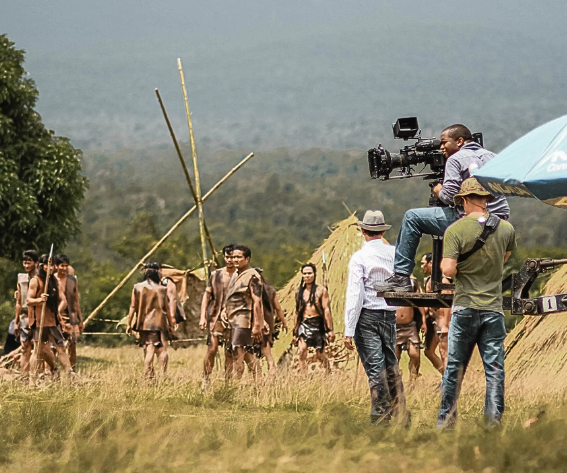
Every film lover eventually discovers that watching movies is only half the experience, because the other half begins when stepping inside them. Standing where a scene happened transforms fiction into memory. When planning a trip inspired by movies, practical details are the invisible crew members that make the production possible. Staying connected is vital for mapping out exact coordinates, which is why many travelers research a Holafly alternative to roaming in Vietnam before heading into the highlands or busy streets. The moment someone arrives somewhere previously seen only through a camera lens, travel stops being tourism and becomes participation.
Film locations act as emotional anchors since directors rely on geography to communicate mood faster than dialogue ever could. A desert suggests isolation, a neon city suggests temptation, and a quiet mountain suggests reflection. When audiences visit these places, they are not simply recognizing scenery but reconnecting with emotions they already experienced while watching.
Why Directors Fall in Love With Real Places
A real location carries texture that studios struggle to recreate because imperfection makes a frame believable. Weather alters lighting, street noise shapes pacing, and architecture carries history without explanation. All these variables combine to create atmosphere that cannot be entirely planned.
Historic European cities illustrate this perfectly. Cobblestone streets and layered architecture naturally create a sense of time depth, which explains why period dramas repeatedly return to Prague, Budapest, and Rome. The camera does less work when the world already tells the story.
Natural landscapes offer another advantage by providing emotional scale. Adventure films rely on viewers believing characters are small compared to their surroundings, and mountains or oceans achieve this instantly. Computer generated imagery can imitate the appearance but rarely the emotional weight.
The Tourist Who Watches Differently
Travel shaped by cinema changes behavior in subtle ways because the visitor is not only observing but remembering. Instead of casually photographing landmarks, people begin recreating shots, waiting for the same angle of sunlight, and studying framing choices made by the director.
When standing in an alleyway seen in a thriller, attention shifts away from storefronts and toward perspective. The viewer considers camera height, direction of movement, and how light falls across the scene. A normal street quietly turns into a lesson in cinematography.
Memories formed this way also feel different. Rather than recalling monuments, travelers recall sequences, and a single day often feels structured like a montage instead of a schedule.
Asia and the Rise of Location Driven Travel
Over the past decade Asia has become a major destination for film inspired tourism because filmmakers discovered how visually diverse the region can be. Megacities, jungles, temples, rivers, and coastlines often exist within short travel distances.
Vietnam demonstrates this range clearly. Limestone karsts, river towns, colonial architecture, and crowded markets allow multiple genres to exist within one country. A romance fits naturally into lantern lit streets, an action film into dense jungle terrain, and a historical drama into imperial ruins.
What makes visiting especially memorable is contrast. Moving from noise to silence within a single afternoon feels cinematic since editing often uses contrast to signal emotional transition.
The Psychology of Visiting a Film Scene
People often feel unexpectedly emotional at filming locations even when nothing is happening because memory attaches to narrative. The brain links a place to the moment the film was first experienced, including surrounding emotions and personal context. When the location is encountered physically, the earlier emotional state resurfaces.
This explains why some locations become pilgrimage sites. Fans are not only honoring a production but revisiting a moment in their own lives. Films watched during childhood or important periods tend to produce the strongest reactions years later.
How Locations Change After Fame
Film exposure inevitably transforms places, sometimes subtly and sometimes dramatically. Small towns may become international stops almost overnight, cafes rename menu items after characters, and locals learn production trivia whether they want to or not.
The changes are not purely commercial. Visitors often slow down, linger longer, and observe more carefully. The atmosphere shifts from transit to immersion.
For filmmakers, this creates a paradox. A location gains popularity because it feels authentic, yet popularity gradually alters that authenticity, forcing future productions to search elsewhere for the same untouched quality.
Planning a Film Inspired Trip
Travel guided by cinema benefits from preparation that resembles research rather than scheduling. Rewatching the film before departure helps identify landmarks, lighting conditions, and timing choices, especially since many scenes depend heavily on early morning or sunset rather than midday light.
Arriving early helps preserve immersion because crowds disrupt mood, while silence enhances it. Even ambient sounds such as footsteps, wind, or distant traffic contribute to the illusion that a character might appear at any moment.
Listening to the film score through headphones can intensify the experience by merging remembered sound with physical presence, allowing memory and reality to overlap.
Cinema as a Map
Films function as cultural maps disguised as entertainment, guiding viewers across borders long before passports are stamped. A city first encountered through dialogue and framing often feels familiar upon arrival despite never having been visited.
This explains the steady growth of film tourism since people are not traveling simply to see places but to recognize them.
Cinema therefore becomes more than storytelling. A scene filmed once can be lived thousands of times by strangers who follow the path of a camera, turning travel into an extension of narrative, supported by saved references, planning tools, and a streamlined digital toolkit that helps transform movie memories into real journeys.
You may also like:




Leave a reply